

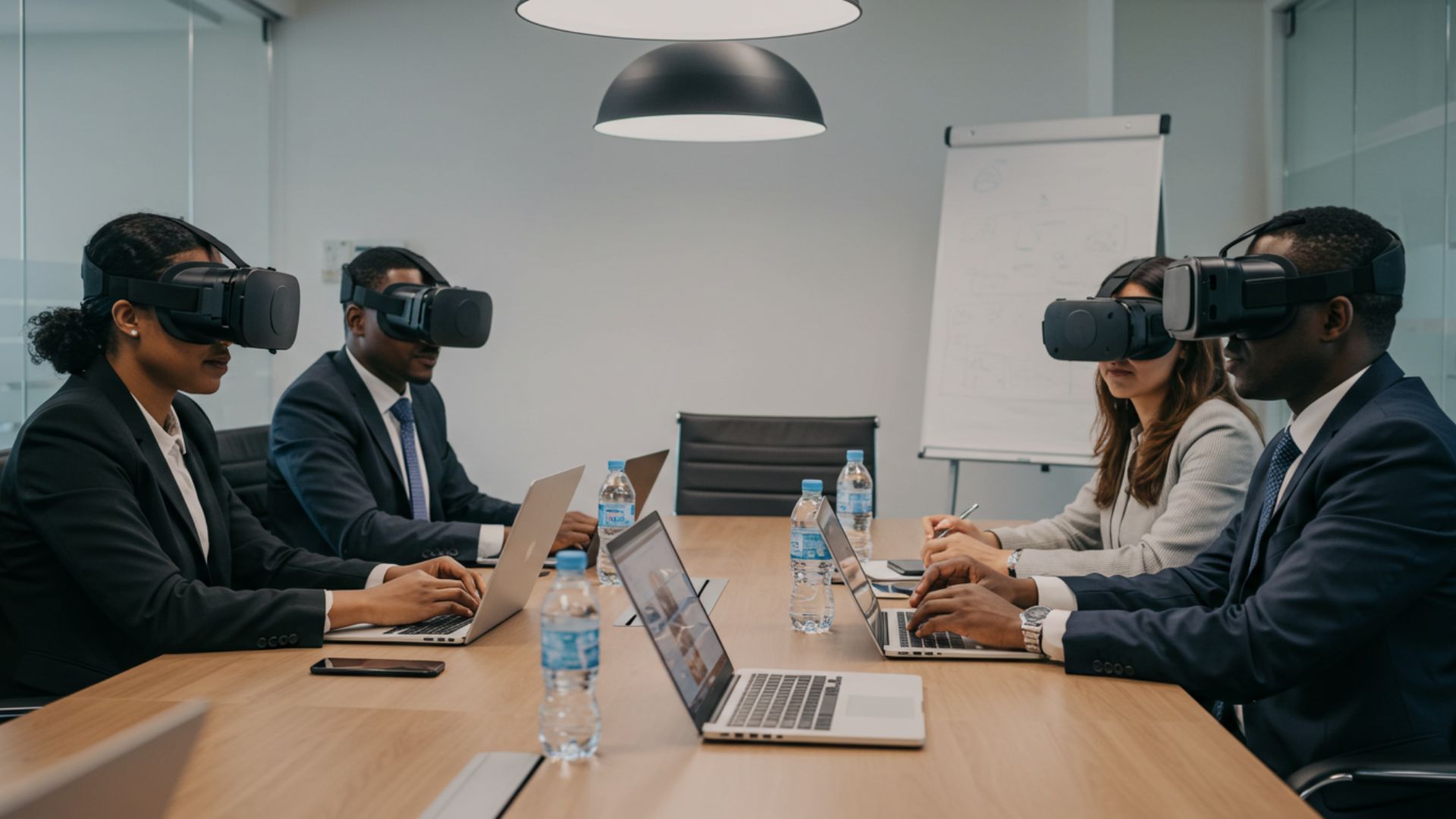
Let’s be honest. The phrase “metaverse” probably conjures images of cartoon avatars and virtual concerts. But for B2B leaders staring down the challenges of remote teams, complex product training, and global supply chains, it’s becoming something far more tangible. It’s morphing from a buzzword into a practical toolkit.
That toolkit is powered by spatial computing. Think of it as the bridge between our physical reality and digital data. It’s not just about putting on a headset; it’s about making digital information interact with our world—and with each other—as if it were physically present. And this, well, this changes everything for how businesses work together and skill up their people.
From Flat Screens to Shared Spaces: The New Face of B2B Collaboration
We’ve all been there. The twentieth video call of the week. Staring at a grid of faces while trying to parse a complex 3D CAD model on a 2D screen. It’s inefficient, frankly. It’s like trying to describe a sculpture over the telephone.
Spatial computing and metaverse platforms smash that limitation. Imagine a persistent virtual workspace where your distributed engineering team can gather around a life-size, interactive prototype of a new turbine. They can walk around it, point to specific components, pull it apart with a gesture, and see real-time stress simulations draped over its surface. The sense of shared presence is profound. You’re not just sharing your screen; you’re sharing a space.
Key Use Cases for Immersive Collaboration
- Design & Prototyping: Automotive and aerospace companies are already using shared virtual spaces for design reviews. Stakeholders from different continents can inspect, annotate, and modify models together, slashing iteration time and travel costs.
- Virtual Site Visits & Facility Management: A client can don a headset and be “walked” through a factory floor that’s still under construction halfway across the globe. They can check pipe layouts, ask questions, and make decisions—no flight required.
- Complex Data Visualization: Financial or logistics data can be projected in 3D, allowing teams to literally see patterns, bottlenecks, and opportunities in a way a spreadsheet could never reveal.
Training That Sticks: The Power of Learning by Doing, Virtually
Here’s where the potential gets staggering. Traditional B2B training—for field technicians, surgeons, or plant operators—is incredibly costly. It requires physical equipment, dedicated facilities, and, often, taking critical machinery offline. And the risk? Real mistakes on real, expensive assets.
Immersive training in the metaverse flips this model. It creates a safe, repeatable, and scalable environment for mastery. Trainees can practice procedures on a photorealistic virtual copy of a $2 million MRI machine or a volatile chemical processing unit. They can fail, learn from the mistake, and reset instantly—with zero risk.
| Traditional Training | Spatial/Metaverse Training |
| High cost (facilities, equipment, travel) | Lower marginal cost after initial development |
| Risk of damage or injury during practice | Risk-free simulation environment |
| Difficulty scaling across global workforce | Instantly scalable; one module, infinite users |
| Knowledge retention can be variable | “Muscle memory” & spatial recall boost retention |
The data backs this up. Studies consistently show that learning retention rates are significantly higher with immersive, hands-on methods compared to passive watching or reading. You’re not just told how a pump works; you assemble it, virtually, with your own hands.
Navigating the Hurdles (They’re Real, But Not Insurmountable)
Okay, so it’s not all smooth sailing. Adoption faces real barriers. The hardware—VR/AR headsets—is getting better and cheaper, but it’s still an investment and a change in habit. There’s a learning curve for teams. And let’s not forget the elephant in the room: interoperability.
Will your metaverse platform from one vendor seamlessly connect with a client’s system from another? The industry is grappling with this. The vision of a single, open metaverse is… aspirational. For now, the pragmatic path is often focused, enterprise-specific virtual environments that solve a specific pain point—like a custom training simulator or a dedicated collaboration hub for a joint venture.
A Practical Starting Point for B2B Companies
- Identify a High-Impact, Contained Problem: Don’t try to rebuild your entire company in VR. Start with a single use case. Is it onboarding for field engineers? Remote assistance for complex repairs? Prototyping for your design team?
- Pilot with a Willing Team: Choose a group open to new tech. Measure everything: time saved, error rates reduced, feedback scores.
- Focus on Integration, Not Isolation: The best tools plug into your existing workflow. Can the virtual training module feed data into your LMS? Can the collaboration space integrate with your CAD software and Microsoft Teams?
The Human Layer in a Digital World
This is the crucial bit, the thing that’s easy to miss when we get dazzled by the tech. Spatial computing isn’t about replacing human connection; it’s about augmenting it across distances. It’s about restoring the nuance of a pointed finger, the shared glance at a problematic component, the spatial understanding that comes from walking around an object together.
That said, the “metaverse for business” doesn’t need to be a fully immersive, all-day headset experience. Sometimes it’s an AR overlay on a tablet guiding a warehouse picker. Sometimes it’s a 3D model accessible on a web browser for a quick client review. The spectrum is wide.
The core of this shift—the real trend here—is a move from information transfer to shared experience. We’re moving past sending files and links, and towards inhabiting the same contextual space, even if that space is made of pixels. It’s a more intuitive, more human way to work and learn, strangely enough. It’s about making the complex tangible, the remote present, and the risky safe. And that’s a future worth building, together.