

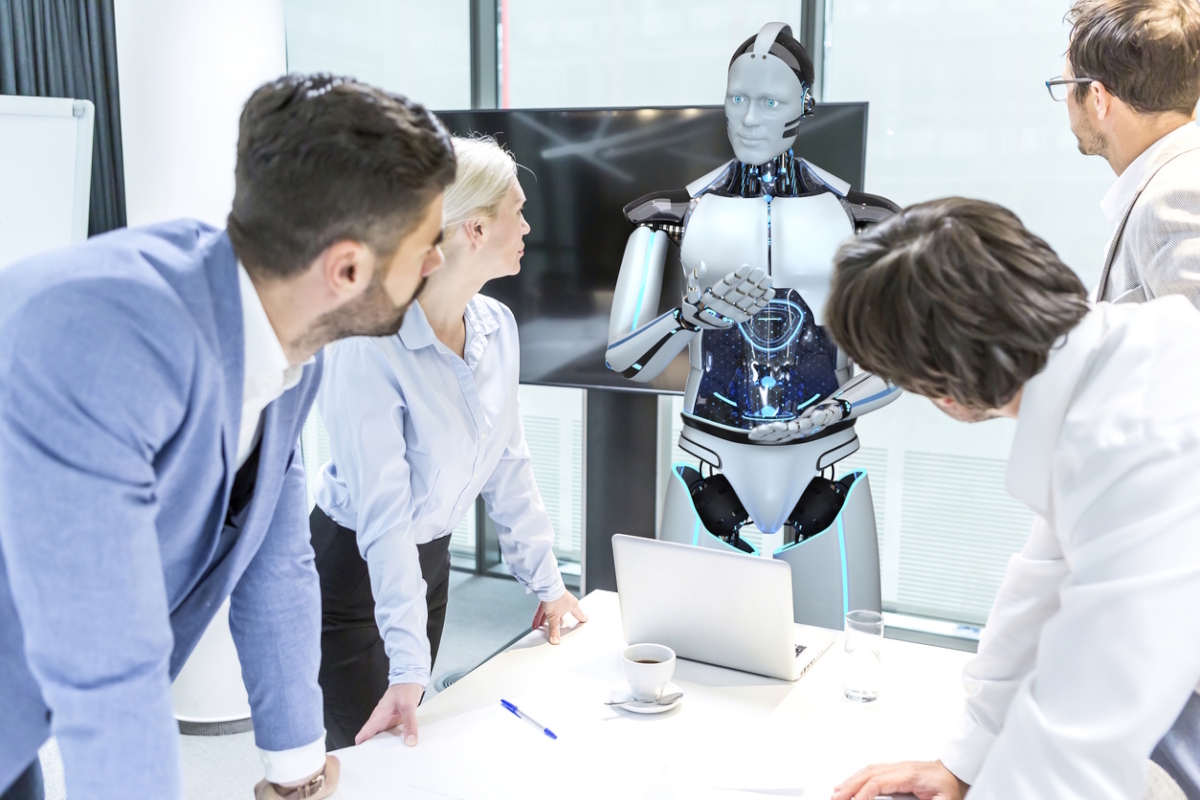
Let’s be honest. The manager’s playbook is getting a serious rewrite. It’s not just about people anymore. Now, you’re leading a hybrid orchestra of human talent and AI agents—algorithms that write code, analyze data, draft content, and automate workflows. It’s exhilarating and, frankly, a bit daunting.
The old command-and-control style? It’s obsolete. Your new role is less of a traditional boss and more of a conductor, a translator, and an ethical guide. You’re cultivating a garden where human intuition and machine precision grow together. So, how do you cultivate the skills to thrive in this new reality? Let’s dive in.
The Mindset Shift: From Overseer to Orchestrator
First things first—you gotta reframe the job. An AI-augmented team isn’t a replacement strategy; it’s an augmentation strategy. Your goal is synergy. Think of it like this: you’re not a pilot manually flying the plane, you’re the mission commander overseeing a highly advanced autopilot system, stepping in for course corrections, creative strategy, and handling the unexpected turbulence no algorithm saw coming.
This requires a blend of humility and curiosity. You need to be comfortable not being the smartest entity in the room. Your value shifts from knowing all the answers to asking the right questions—of both your team and the AI tools at their disposal.
Key Shifts in Focus
- From Task Allocation to Workflow Design: You’re designing the process itself—deciding what the AI handles, where human judgment is inserted, and how the handoffs happen seamlessly.
- From Quality Control to Quality Curation: AI generates; humans curate, contextualize, and add the emotional or brand-specific nuance. You’re managing that curation process.
- From Providing Answers to Facilitating Experimentation: “What happens if we prompt the model this way?” becomes a core team discussion you lead.
Core Skills for the AI-Augmented Manager
Alright, with the mindset in place, what specific managerial skills need honing? Here are the non-negotiables.
1. The Art of Prompt Engineering & Briefing
This is arguably the most crucial new skill. You don’t need to be a coder, but you must master the art of the instruction. Prompt engineering for AI tools is directly analogous to briefing a human team member—just with less room for ambiguity.
A vague brief gets vague results, from both humans and AI. But with AI, the feedback loop is faster. You learn to iterate prompts in real-time. The skill here is decomposing a complex goal into a sequence of clear, contextual instructions. It’s part psychology, part linguistics, and part process design. You’re teaching your team to do the same.
2. Data Fluency, Not Just Literacy
You won’t always be the one running the analysis. But you absolutely must be able to interpret AI-generated insights and challenge them. This means understanding enough about data sources, potential biases, and what “confidence intervals” actually mean to ask: “Is this result statistically significant, or just a pattern in the noise?”
It’s about spotting when the AI’s beautiful dashboard might be telling a misleading story. Your team will look to you to separate the signal from the noise.
3. Fostering “Augmented” Creativity & Problem-Solving
Here’s a common fear: “Will AI make us less creative?” The manager’s job is to ensure the opposite. Use AI as a brainstorming partner that never runs out of ideas—most of which will be mediocre, but a few might spark human genius.
Facilitate sessions where the team uses AI to generate 100 solutions to a problem, then applies human experience, ethics, and gut feeling to select and refine the top three. You’re managing a new creative workflow, one that starts with a broad AI-generated landscape and ends with deep human craftsmanship.
4. Ethical Guardrails and Change Management
This is the heavy one. AI introduces a minefield of ethical questions—from bias in hiring algorithms to copyright issues with generated content. You are the first line of defense. Cultivating ethical oversight for AI workflows means establishing clear guardrails and fostering a culture where the team feels safe to flag potential issues.
And let’s not forget the human element. People are anxious. Your role as a leader involves transparent communication about how AI is a tool to elevate their work, not replace them. You’re managing both the technology and the emotional landscape.
Practical Table: Redefining Common Management Scenarios
| Traditional Scenario | AI-Augmented Approach | Manager’s Key Action |
|---|---|---|
| Weekly Performance Review | Analyzing AI-generated productivity dashboards + qualitative human feedback. | Interpreting the data trends to ask coaching questions, not just measure output. |
| Project Brainstorming | Using AI to generate initial concepts, which the team then critiques and expands. | Facilitating the “yes, and…” session between human and machine ideas. |
| Risk Assessment | Running simulations with AI predictive models alongside team’s experience-based forecasts. | Balancing the algorithmic probability with intuitive “unknown unknown” insights. |
| Delegating a Report | Assigning first draft to an AI tool, with a human team member owning analysis, narrative, and insights. | Crafting the precise prompt and defining the human value-add stages clearly. |
The Human Touch in a Hybrid Workflow
With all this talk of tech, never forget—your primary job is still to lead people. AI can’t build trust, mediate conflict, or inspire a team with a compelling vision. In fact, as workflows become more automated, the human elements of leadership become more valuable, not less.
Your empathy, your ability to read a room, your understanding of unspoken motivations… these are your superpowers. Use them to:
- Identify when someone is feeling obsolete and reassure them by reframing their role.
- Celebrate the creative leaps a team member made after using an AI-generated starting point.
- Protect your team’s time for deep, uninterrupted human thinking—the kind that AI can’t replicate.
Looking Ahead: It’s a Continuous Learning Curve
Here’s the deal: the tools will keep changing. New models, new capabilities, new headaches. The core skill you’re really cultivating is adaptive learning. It’s about staying curiously skeptical, being willing to play with new tools, and fostering a team culture where learning is part of the daily work.
Don’t aim for perfection. Aim for progress. You’ll sometimes mis-prompt an AI. You’ll sometimes over-trust an algorithm. That’s okay. The best managers of AI-augmented teams aren’t tech gurus; they are humble, clear-communicating, ethically-minded, and relentlessly focused on human potential. They understand that the machine is for optimization, but the team—the human collective—is for transformation.
And that’s a transformation worth leading.